

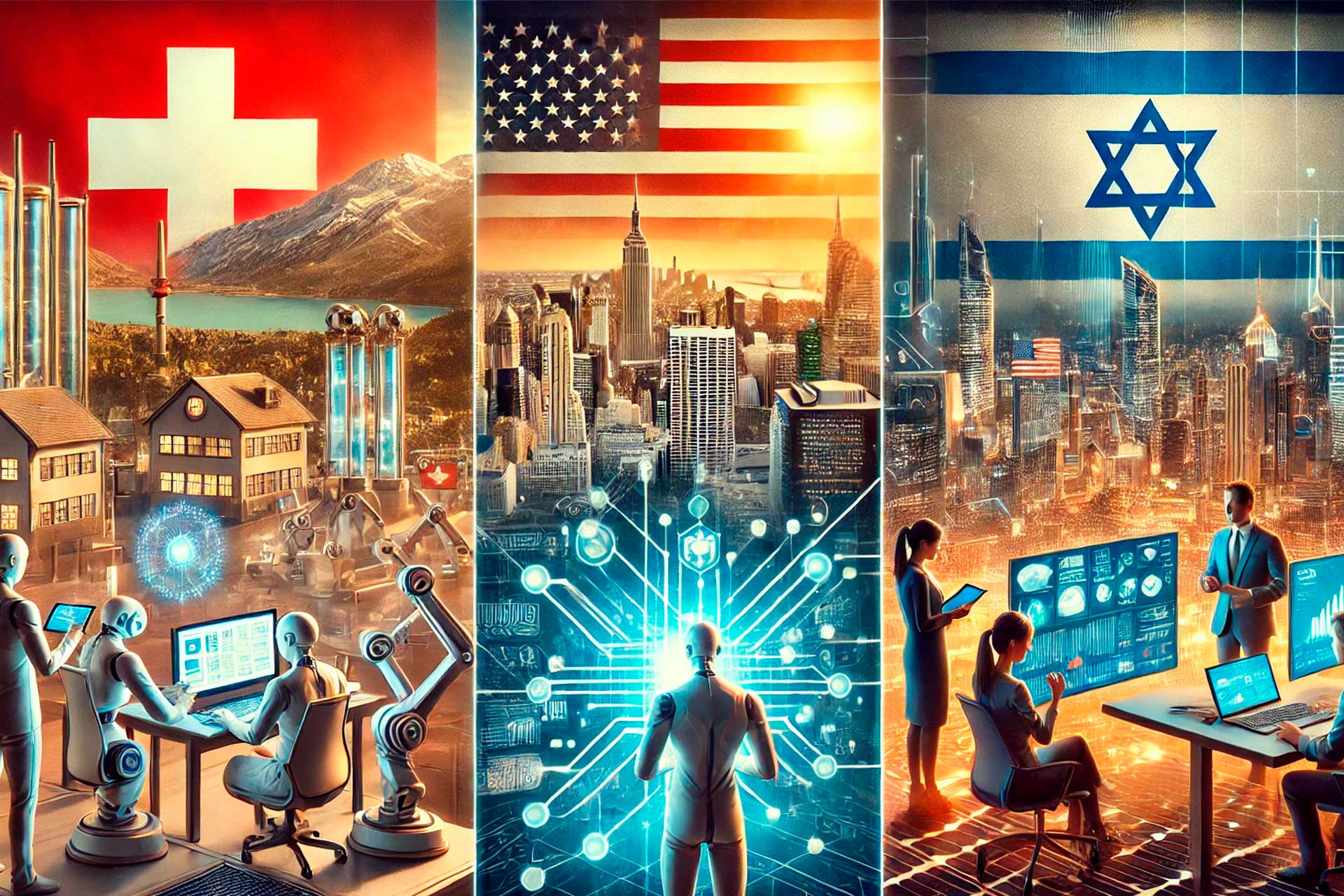
In the global innovation landscape, Switzerland, the United States, and Israel represent three benchmark models, each distinguished by unique characteristics, specific strengths, and complex strategic approaches. Let’s explore the differences between these three of the world’s most innovative nations.
Switzerland: academic research and industrial deep tech
Switzerland has built an innovation ecosystem based on:
- a globally recognized scientific research network
- political stability
- strong collaboration between universities and businesses
ETH Zurich and EPFL Lausanne are among the most prolific universities in Europe for tech spin-offs, having generated over $100 billion in enterprise value. According to the article How Switzerland Transformed Itself Into A Deep Tech Global Leader (Forbes), Switzerland ranks first in Europe and third globally for Deep Tech investment per capita, with $2.3 billion projected in 2025.
Zurich has become a true AI powerhouse, with startups like Neural Concept and Ethon.ai raising $27 million and $16 million respectively.
Recently, the global tech community took notice of the $1 billion exit of Nozomi Networks, a scaleup specializing in cybersecurity for critical infrastructure. Originally founded between Varese and academia, Nozomi expanded rapidly, establishing its headquarters in San Francisco and its European R&D center in Mendrisio, Ticino. From this Swiss base, Nozomi supports global operators in reducing cyber risks and increasing infrastructure resilience. Acquired by Mitsubishi Electric, Nozomi continues to operate independently. According to its Italian founders, the Mendrisio center remains a strategic asset due to the quality of local talent and proximity to academic and industrial hubs. The decision to maintain a Swiss base is tied to the country’s stability, strong IP protection, and ability to attract international talent and investors. Among Nozomi’s major shareholders is Planven, an Italo-Swiss firm based in Zurich and a member of the Italian Chamber of Commerce for Switzerland.
Other sectors such as robotics, climate tech, medtech, and biotech are also experiencing steady growth. Switzerland stands out for its cooperation between startups and large corporations, which act as both partners and market accelerators. This approach fosters technological scalability and industrial maturity of innovative solutions.
For entrepreneurs and startup founders, Switzerland’s competitive edge lies in its high-quality talent pool, robust IP protection, and its ability to attract foreign investment—with tech giants like Google, Microsoft, Meta, and OpenAI already operating in the country.
USA: scale, capital, and risk culture
The United States remains the global innovation giant, with a deep and diverse startup ecosystem fueled by a business culture that rewards risk and speed. In Q1 2025, the U.S. market recorded $103.9 billion in private funding, driven by mega-rounds like OpenAI’s $40 billion raise.
Silicon Valley, New York, and Boston continue to dominate, but new hubs like Austin and Miami are emerging. The American model is ideal for those seeking fast access to capital, global scalability, and strategic exits. However, fierce competition and pressure to grow quickly can be challenging for early-stage startups.
For European entrepreneurs, the U.S. offers a powerful expansion platform—but it requires a well-structured market entry strategy, a local team, and strong adaptability.
Israel: agility, density, and market-driven innovation
Israel, often referred to as the Startup Nation, has the highest number of startups per capita in the world. The country has built an agile, market-oriented ecosystem, strongly supported by public policies and private investment. According to the report The Israeli High-Tech Sector at a Crucial Crossroads, Israel is now considering a strategic shift—from “Startup Nation” to a sustainable “Tech Nation”—aiming to integrate global innovation with local impact through targeted solutions.
Universities like the Technion and Weizmann Institute are talent powerhouses, and Israeli startups are frequently acquired by multinationals (e.g., Mobileye by Intel). The country excels in cybersecurity, AI, agritech, and watertech, with a strong tendency toward rapid internationalization.
For entrepreneurs, Israel offers a lean, dynamic, and experimental environment where failure is seen as part of the growth process. However, the limited size of the domestic market makes early international expansion a necessity.
Which strategy wins?
For those operating in Italy or Europe, combining elements from these three models can be a winning strategy: local grounding, global vision, and adaptability.
- Switzerland: Build innovation on solid foundations, with strong scientific and industrial components.
- USA: Scale fast, attract capital, and compete globally.
- Israel: Be agile, market-driven, and capable of turning research into products.