

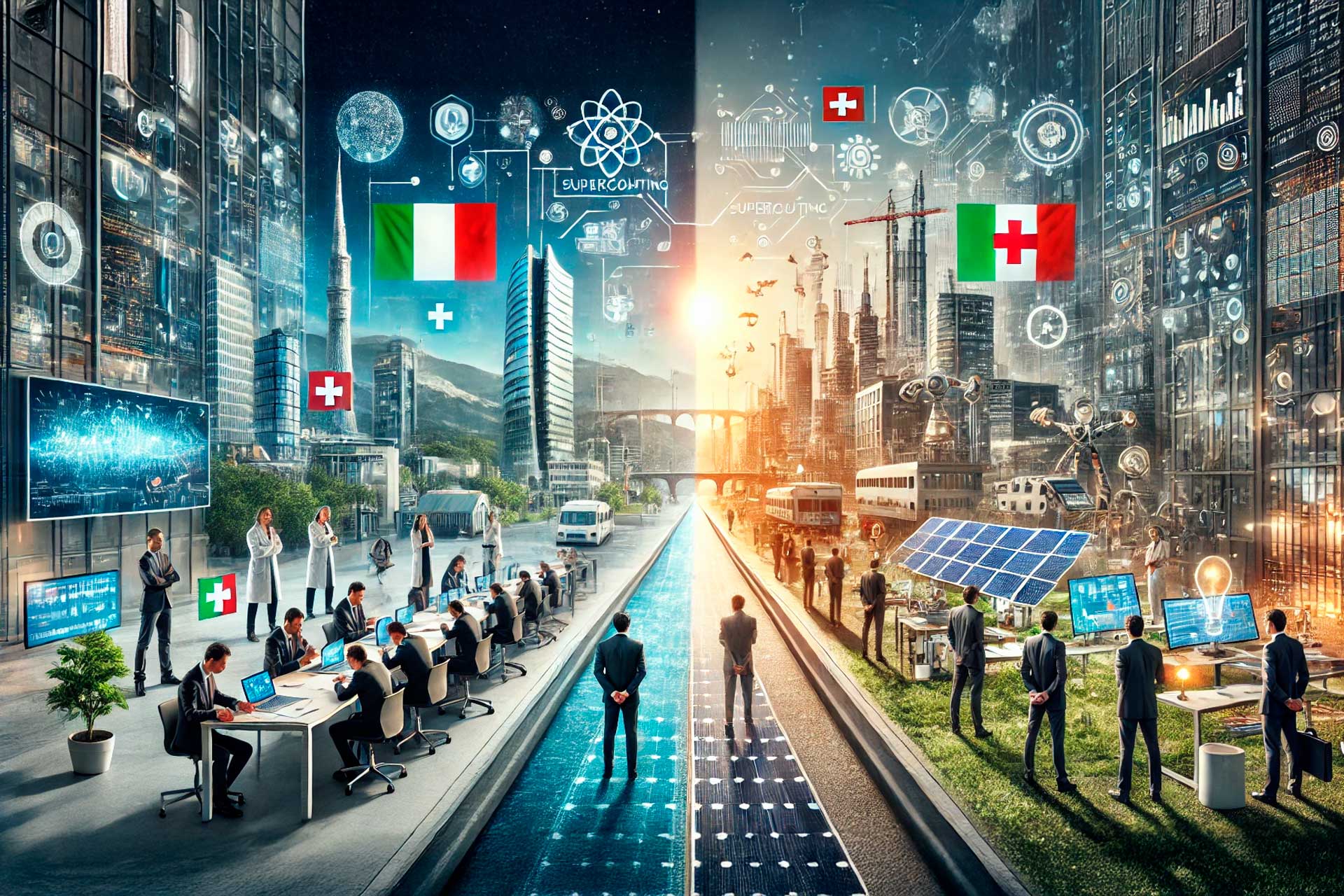
In the European innovation landscape, Italy and Switzerland represent two very different yet potentially complementary realities. On one hand, Switzerland has ranked among the most advanced ecosystems in the world for over 14 years; on the other, Italy is experiencing significant growth, despite starting from a more fragile and fragmented base.
Comparing numbers: investments and startups
In 2024, tech startup investments in Switzerland exceeded 2.4 billion CHF, while in Italy they reached 1.07 billion CHF (approximately 1.13 billion euros). Despite the gap, Italy recorded a +7.5% growth compared to the previous year, indicating increasing momentum.
The number of innovative startups reflects this difference: over 26,000 in Switzerland versus just over 12,000 in Italy. Yet, considering that Italy has six times the population and three times the GDP of the Confederation, the gap highlights how much more mature and structured the Swiss ecosystem is.
Deep tech planisferium
One of the most interesting aspects of the innovation ecosystem is the geographic distribution of investments, which reveals much about a country’s maturity and balance.
In 2024, the Lombardy Region recorded 659 million CHF in tech startup investments, even surpassing the Canton of Zurich, which reached 632 million CHF. This surprising figure highlights Milan’s attractiveness as a tech and financial hub, but also the strong territorial concentration of investments in Italy.
Indeed, after Lombardy, the gap is clear: Tuscany raised 102 million CHF, Lazio 73 million, and Piedmont 65 million. The rest of the country remains highly fragmented, with an ecosystem still in consolidation and marked by strong disparities between North and South.
In Switzerland, although Zurich attracts about a third of national investments, the system is much more balanced. Hubs like Lausanne, Geneva, Basel, and Bern contribute significantly, with a total of 760 million CHF invested in 2024. This demonstrates a broader distribution of innovative capacity and a network of interconnected regional ecosystems, often linked to top-tier universities and vertical industrial clusters.
Regional ecosystems compared: practical examples
- Zurich is home to ETH and numerous AI and fintech scaleups, such as Neural Concept and Swiss-Mile, and serves as a hub for international investors.
- Lausanne, with EPFL, is a center of excellence for deep tech and robotics.
- Geneva hosts the Campus Biotech and many startups in the medtech and biotech sectors.
- Basel is the heart of the pharmaceutical and life sciences industry, with companies like Novartis and Roche collaborating with local startups.
In Italy, Milan concentrates most resources, but emerging hubs include:
- Turin, focused on mobility, AI, and advanced manufacturing.
- Bologna, gaining recognition in supercomputing and foodtech.
- Naples and Bari, which, thanks to PNRR funds and dynamic universities, are attracting investments in cybersecurity and smart cities.
This analysis shows how the territorial distribution of investments is a key indicator of ecosystem maturity. Switzerland, though smaller, demonstrates greater cohesion and diffusion of innovation, while Italy needs to strengthen emerging hubs and bridge territorial gaps to make its system more resilient and competitive.
Strategic complementarity: a win-win relationship
Despite their differences, the two countries present strong complementarities that can turn into concrete opportunities:
- For Italian startups, Switzerland offers an ideal acceleration platform: thanks to programs like those from Innosuisse, the presence of angel investors (e.g., SICTIC), and the university hubs in Zurich and Lausanne, startups can scale internationally more quickly.
- For Swiss startups, Italy offers a vast and dynamic tech demand base. With the second-largest manufacturing sector in Europe and a growing inclination toward innovation through Industry 4.0 and 5.0 programs, the Italian market is ready to embrace high-value tech solutions.
A bridge for innovation between northern and southern europe
As Fabrizio Macrì, Secretary General of the Italian Chamber of Commerce for Switzerland, emphasized: “Technology is the stimulus that can help Italian companies regain competitiveness. Switzerland, with its advanced ecosystem, can be a strategic partner in this transformation”.